Most poultry operations do not lose money because the manure is worthless. They lose it because drying, crushing and pelleting are sized separately, and the plant never reaches the rate the quotation promised. The order in which you make those decisions is what keeps the numbers honest.
Size the line from your weekly manure volume
A chicken manure processing line should be sized backwards from what your houses produce each week, not forwards from a machine's rated output. Manure arrives wet, and the tonnage you collect is not the tonnage you bag. Confirm the working moisture window with your supplier before accepting any capacity figure.
Decide how you will stabilise the raw material
Farm litter carries grit from bedding and feed, which abrades dies and rollers faster than most organic feedstock. Poultry litter is also high in nitrogen, so the material has to be stabilised before it can be dried and shaped. A poultry waste composting system turns fresh manure into something consistent enough for the next step.
Treat drying, crushing and granulation as one section
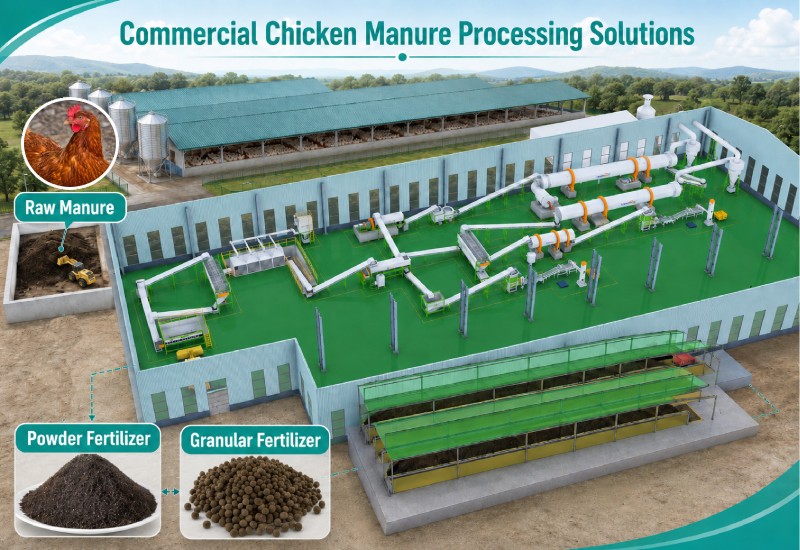
These three steps decide the quality of everything downstream. If drying is uneven, an organic fertilizer production line produces soft pellets and clogged dies; if crushing is coarse, the granulator cannot form uniform pellets at all. One owner for the whole section prevents the arguments that follow a bad batch.
Compare the two plans against your market
One route composts and bags for local buyers. The other adds drying and shaping for customers who need uniform pellets that survive transport. The chicken manure drying and crushing equipment in the second route is what separates the two, and it usually decides the final cost of the project.
Confirm five points before signing
- Weekly manure volume and how it changes with the season
- Target moisture after drying
- Pellet diameter your buyers ask for
- Available power supply and building footprint
- Wear parts, commissioning and operator training
Manure management and fertilizer production are two halves of the same job, so plan them together. It helps to review how managing poultry waste works upstream before the equipment list is fixed, then learn more about how the two common plans differ.
Send your weekly manure volume and target pellet size for a matched configuration: https://fertilizerequipmentmanufacturer.com/chicken-manure-processing/