When you plan to invest in a fertilizer production project, the equipment price is only one part of the decision. Your total investment is also influenced by raw materials, production capacity, process design, automation level, and future expansion plans. Understanding these factors helps you evaluate the project more accurately before selecting a suitable solution.
Which Factors Influence Your Fertilizer Granulation Plant Investment?
The total budget of a fertilizer project is closely related to your production goals and product positioning. For example, a small local fertilizer producer may focus on a simple configuration, while an industrial manufacturer may need a complete system with automatic batching, drying, cooling, screening, coating, and packaging.
When you compare the fertilizer granulation plant price, you may notice large differences between projects. This is because each plant is designed around different requirements, including capacity, fertilizer type, equipment selection, and automation degree.
Your raw materials also affect the investment structure. A project processing compost, animal manure, or agricultural waste may require different preparation systems compared with mineral-based fertilizer production. For example, a cow manure fertilizer granulation plant often includes fermentation, crushing, mixing, granulation, drying, and packaging sections to transform organic waste into commercial fertilizer products.
How Does Production Process Design Affect Project Cost?
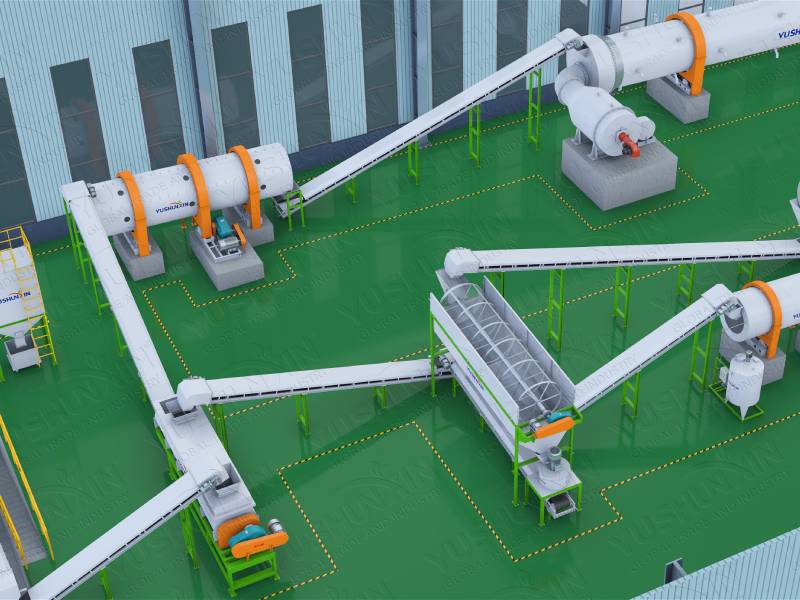
The production route has a direct influence on equipment configuration and operating requirements. A clear fertilizer granulation plant process flow helps you understand how each section connects and where additional investment may be needed.
Different granulation technologies create different project structures. Some customers prefer a simpler granulation line with lower initial investment, while others choose a more complete solution to improve product consistency and market competitiveness.
A turnkey fertilizer granulation plant can integrate engineering design, equipment manufacturing, installation guidance, and production support into one project. This approach allows you to manage the whole production system more efficiently, especially when you are building a new fertilizer factory or upgrading an existing facility.
How Do Raw Materials and Equipment Selection Change the Budget?
Your raw material characteristics influence not only the granulation method but also the supporting equipment. Moisture content, particle size, material hardness, and final product requirements all affect the plant design.
For mineral fertilizer projects, customers often pay attention to crushing, grinding, mixing, and granulation performance. The selection of mineral powder granulation equipment depends on the mineral properties and the required granule specifications.
Besides the main granulator, auxiliary systems such as conveyors, screening machines, dryingequipment, coating systems, and automatic packaging equipment can also influence the final project investment. A well-balanced configuration helps you control both initial costs and long-term production efficiency.
How Can You Plan a More Suitable Fertilizer Project?
Before investing, you can evaluate several key points: your available raw materials, expected output, target fertilizer products, factory space, labor conditions, and future expansion plans. These factors allow the production solution to match your business goals rather than simply focusing on equipment prices.
For more information about fertilizer production solutions, Click here for more details.
A fertilizer granulation project is a long-term investment. When the process design, equipment selection, and production goals are considered together, you can build a system that supports stable operation and future market development.
Learn more about fertilizer granulation solutions here: https://www.shunxin.eu/fertilizer-granulation-plant/